Monday, August 11, 2014

R33 GT-R Design Trivia (Part 3 - Wheels and Tires)

Wheels:

It's common knowledge that BBS Japan made the forged aluminum alloy wheels for R32, R33 and R34 GT-Rs.  What is not as well known is that, in fact, the R33 GT-R wheels were based on the look of the R32 wheels – instead of 5 solid spokes, there are 5 hollowed out spokes (so they appear to be 10 spokes).

R32 GT-R wheel. From: http://www.e-polish.info/sagyou-R32.html
A lovely Midnight Purple car with the OEM wheels. Courtesy of Christopher Ziolkowski

In the beginning, there were two candidates for wheels – a refined/evolved version of the R32, or a new 5 spoke design.  They wanted to go with the first design, but quickly realized that in a 17 inch rim size, the wheel got heavier, which is how they came up with the 2 rib per spoke design.

At the time, the 2 rib wheels were rare, so appropriate for the GT-R. The wheels were also designed to improve the cooling characteristic of the wheel, so that owners could go to the track using the OEM wheels.

There was also a candidate design of 5 flat spokes (like the Ferraris back then), but the dished look won out, to give a sense of fullness and strength.

The R32 wheels, by the way, were inspired by F1 wheels, and their design was done so that the calipers would be visible from above. Same theme with the R33.

Tires:

So what is the difference between the Bridgestone Expedia S-07 tires that came on the V-Spec, vs the Bridgestone RE010s that came on the standard BCNR33?

Both were specifically designed for the GT-R, and we would expect to be the S-07 to be higher performance tire... which is true to an extent.

Bridgestone S-07 From: http://www.croooober.com/item/1876796

 RE010 From: http://minkara.carview.co.jp/en/userid/167168/car/143531/2987993/parts.aspx

It turns out that the RE010s were better all around tires, while the S-07 were better in the dry but not so good in the wet.  Most interesting however is that the S-07’s design minimized tire noise (to those on the outside, due to new noise regulations for cars passing in 1998.)

For the UK spec R33 GT-Rs, it's not surprising they were fitted with the RE010s due to their all weather characteristics.

Next post - How the R33 GT-R improved upon the R32 GT-R, Part 1 (High Traction Layout, Aerodynamics)

Monday, August 4, 2014

R33 GT-R Design Trivia (Part 2 - Emblem, Steering Wheel and Gauges)

Continuing on the theme of interesting stuff I found out when researching how the R33 GT-R improved upon the R32 GT-R:

The Emblem:


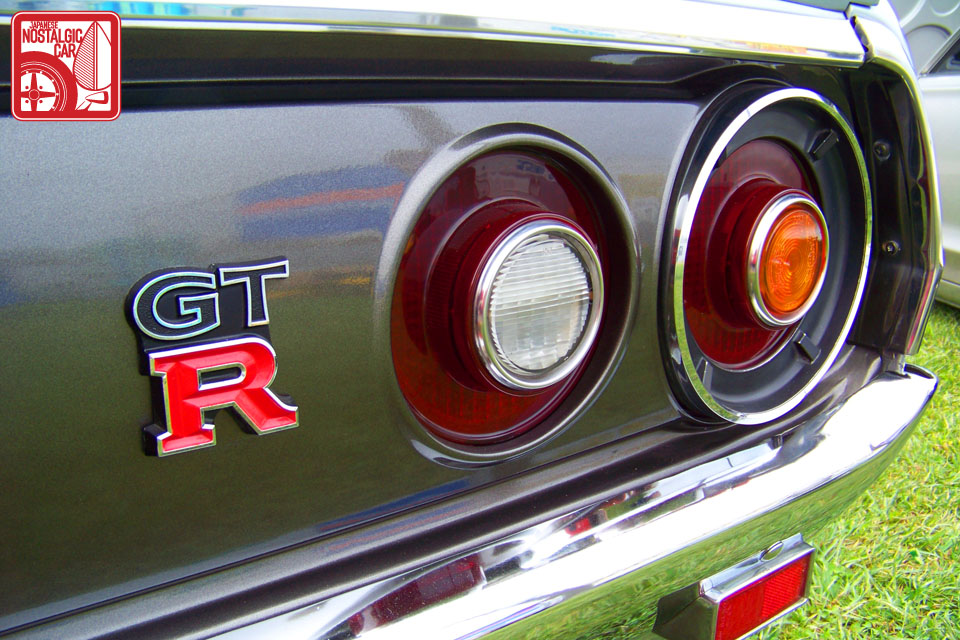
Nissan’s design division has one division that specializes only in emblems. For the RB26 GT-Rs, the GT-R logo used on the Ken Mary GT-R that debuted in Jan 1973 was the inspiration. That is, “GT” on top, a larger “R” on the bottom, and the “R” letter actually being silver outlined with red being painted within the outlines, to give it more presence.

From: http://japanesenostalgiccar.com/2011/09/13/events-2011-japanese-classic-car-show-part-01/
It turns out that at the time of the R32, the general design trend was to minimize badging or make them smaller, in order to give a clean look to the front of the car. Thus, the GT-R, like all R32s, only had the “S” symbol on the front hood, and only had the GT-R badge on the trunk.

However, the R33’s development chief Kozo Watanabe (who would later be in the same role for the BNR34), insisted on having a largish GT-R logo in the front as well, in order to strongly emphasize the car was a GT-R.  This was in order to let cars ahead, when looking in the mirror, see that a GT-R was closing in from behind!
So this is the view in the mirror as a lesser car is about to be passed.
From: http://www.skylinesaustralia.com/forums/topic/237956-in-motion-pics-of-my-r33-gtr/
Nissan's chief designer of the exterior of the GT-R, Hiroshi Nishiizumi, had this to say about the GT-R logo:
“The large GT-R emblem is in the middle of the grill because there is only ‘dead space’  - the hood latch - behind it, so it hides this part which we don’t want to see.  Also, the GT-R lettering is two level, just like the GT-R logo for the Ken /Mary GT-R.”

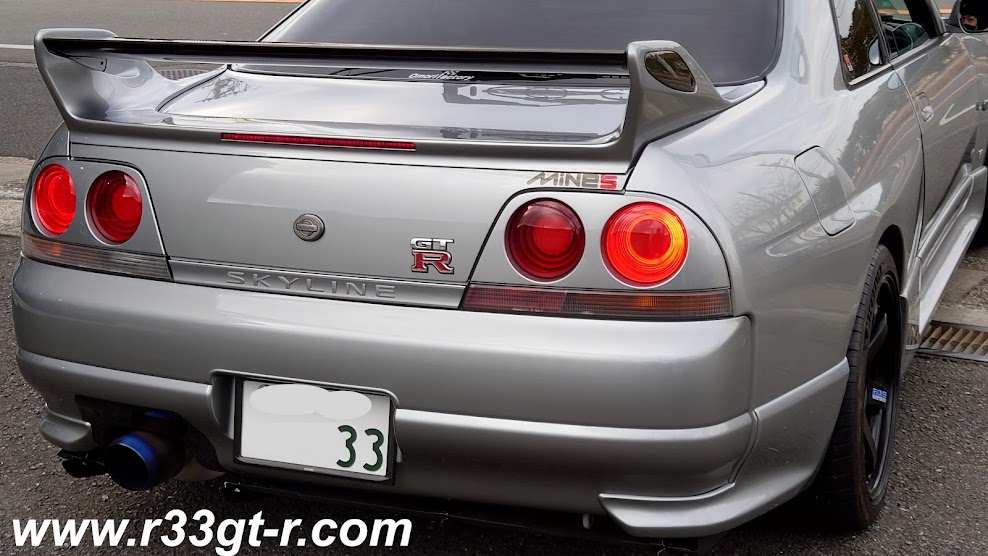
There is also a “GT-R” that is inscribed only on the left cover to the rear spoiler.  Ever wonder why it’s only on one side?
From: http://www.driftireland.com/forum/showthread.php?36087-Genuine-R33-GTR-Spoiler
This was done so that a driver being PASSED by a GT-R (in the fast lane in right hand drive countries,) would see at eye level, at the moment of being passed, what car had just passed him!

The logo designer was Ms. Junko Ito, who said her marching orders were to come up with an elegant and sporty design, larger than the 32 design on which it was based to reflect the larger mass of the 33, and fit it al into a square, while remaining well balanced.  The "R" was made larger than the "GT", and there was a black background to the letters.  Further the red used was more crimson than the brownish red used in the 32.

The Steering Wheel:

This is one area where I think the R32 is better -  its steering wheel, which was inspired by Porsche and BMW designs.  The objective here was being able to turn the wheel by sliding your fingers. It is simple, clean and functional:
From: http://jp.autoblog.com/2013/03/03/nostalgic-2days-2481km-r32-skyline-gt-r/
We all know that by the time of the R33, airbags were becoming mandatory.  Hence the Series 1 BCNR33 had that monstrosity of a steering wheel taken from the Nissan parts bin.  It did not even have the sporty red stitching found on the more compact steering wheel found on the Series 2 and 3:

Series 1 on left, Series 2 and 3 on right
I guess it could have been worse? The R33 GT-R Prototype's steering wheel:
Actually, this looks better - at least smaller - than the Series 1 one.
All three photos above from: http://www.gtr-world.com/
What is NOT known is that it turns out the second steering wheel (for Series 2 and 3) was actually finished as a product and ready to go by the launch of the R33, but for parts sharing purposes, the decision was made to use the older one that ended up in the Series 1.

So, apologies to Series 1 owners, looks like you guys got stuck with some of the cost cutting going on at the time...

The Gauges:

When designing the R33 GT-R, Nissan designers followed the theme of "road going racer" - so racing drivers as well as Nissan test drivers were asked for the input in designing the interior. One trait as a result was the large number of gauges.

The sub meters were carried over, but improved upon the ones in the R32. On the R32, the gauges were pointed at the driver, but on the R33, in addition to having larger and more readable font, the fascia was cut to allow easy visibility without having to offset the gauges.

OEM R32 GT-R Sub Gauges
From: http://www.gtr-world.com/gt-r/bcnr33/bcnr33-skyline-gtr-4door-autech.html

And all the gauges are all ROUND.  Actually, other parts of the interior are round too, including the clock, harzard, defogger and even the HVAC switches.  This was done on purpose, to create a link to the afterburner tail lamps.  As one designer stated,  "The beautiful circle is the Skyline philosophy."

As for the main gauges, one small detail is the use of the imprinted carbon which in addition to the GT-R logo in the tachometer, was designed to separate the R33 GT-R from non GT-R variants.

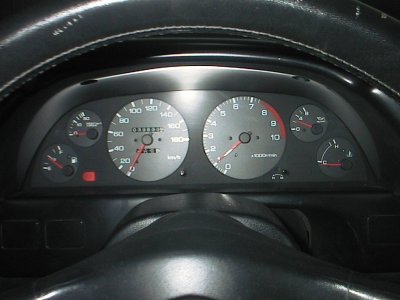
Speaking of the tachometer - unlike in the R32, where the needles of both the speedometer and the tachometer were sitting, at rest, at the 7pm position (see photo above for the steering wheel) or the non GT-R R33, where the speedometer and tachometer needles both begin in the horizontal position -  Why, in the R33 GT-R why does the speedometer needle point to 9pm but the tachometer needle point straight down? I've always wondered about this.

From: http://www.skyline-forum.de/showthread.php/10001-NISMO-R33-320kmh-11k-TACHO

The problem with gauges with needles in the horizontal position (as was found in non GT-R R33 variants) is that the area where the rev limiter would kicks in (at 8000 rpm) is towards the bottom:
Yes, it has the carbon look, but this is a BCNR33 gauge panel installed in an ECR33.
From: http://minkara.carview.co.jp/en/userid/660687/car/1417373/6174645/parts.aspx
For the R33 GT-R designers, functionality was the most important aspect. But they also wanted an emotional connection with the engine as well: they wanted the driver to get excited watching the needle go up and down along with the engine revs.  In other words, the designers wanted the tachometer to have a natural, wide angle of sweep, so the needle would rise from zero at maximum bottom below and peak near the red zone at the very top.   Also, more practically, when driving at high speed, by having 7000rpm at the top center, it was easy to see at a glance that you were approaching the 8000 rpm red zone.

The designers also did a couple other things to emphasize the importance of the tachometer. First, they eliminated the voltage gauge found in the R32, and replaced it with a warning light, and then moved the torque meter to the 3 sub meters in the center stack area.  By eliminating the number of surrounding gauges from 4 to 3 (leaving only one on the tacho side), this made the tachometer appear larger and easier to see.  Also - it turns out that the color of the font on the gauges is actually not white, but a light grey for better visibility.

Compare:
From: http://www.skyliner32.net/HNR32/img/after.jpg

OR:
From: http://minkara.carview.co.jp/en/userid/1558931/car/1155628/4692855/parts.aspx

Amazing the little details they thought about, eh?

Next: R33 GT-R Design Triva, Part 3: Wheels and Tires.

Tuesday, July 29, 2014

R33 GT-R Design Trivia (Part 1 - Seats, Tail Lights and Headlights)

In doing research to discover how the R33 GT-R improved upon the R32 GT-R, I came across some interesting tidbits on the R33 - some items which even I had not thought about before, as well as some which had always bothered me.  Before I post what I found on the improvements over the BNR32, I have three posts on BCNR33 design trivia.

Blue vs Red Interior Stitching:

I've always wondered why Nissan did this. Why was the Series 3 given the red stitching, but the Series 1 and 2 blue stitching? Notably, the seats also have red or blue inserts to reflect the rest of the interior.
From a Series 1 car: courtesy http://www.gtr-world.net/gtr/archive/1858
Series 3 car
It turns out that in the beginning, there WAS argument internally over the stitching color – either red or blue – but blue was finally decided upon as it was Nissan’s image color.

Remember this is how the old logo looked:

The Series 3 cars did make the switch to red – but this was apparently because the main body color switched from midnight purple to silver (as can be seen in the TV commercials):

The "Speed King" commercial when the car was first introduced in 1995:


And then the Series 3 commercial in 1997:


Anyway, as everyone knows, the R33 seats are simply reupholstered R32 seats.  A bit of history on the R32 seats.  When designing the R32 seats, they had 2 goals - seats that could keep up with the GT-R’s performance, and seats ergonomically designed to fit well and allow for long drives without tiring.

So they looked and examined seats from Porsche, racing cars, rally cars, Recaro, and even seats with good reputations from other sports cars.  But the most attention was paid to rally car seats.  Most seats (at the time) really only supported the hips, but rally car seats support the hips, thighs, and shoulders, etc. in several locations.  So the GT-R seat was based around a bucket seat design found in rally cars. Data on how the muscles move, blood flows were recorded and used.  Initially, the seats held the shoulders more securely, but test drivers and journalists all reports this to be tiring in nature, so the shoulder areas were trimmed. 

Also two different sizes were considered for larger and smaller drivers but eventually only one size was selected.

For the R33, different seats were again examined, including those from Group C cars, but they settled back on the R32 seats.

As for the seat material – initially the same stuff “exse-nu” (not sure of the spelling, as the name was in Japanese in the reference text) as on the R32 was considered,  but a better material with better feel and finer fibers called Lux Suede was used. Although a NASA space material and real suede were also candidates, Lux Suede was selected in order to keep the seats as light as possible.

Incidentally, the rear seats of the R33 were designed in response to complaints that the rear seats in the R32 were too uncomfortable. (Both photos below courtesy of SkylinesAustralia.com)
R32 GT-R Rear Seats

R33 GT-R Rear Seats

Head and Tail Lamps:

Nissan designers had to design the head and tail lamps within the parameters of two design elements specific to the Skyline.  Everyone knows about the 4 rear afterburners (which in fact WERE inspired by the afterburners of jet fighters), but the designers also had to follow the Skyline custom of having 4 head lights as well - apparently, every Skyline from the beginning had 4 lights up front, which is not true of all cars, for example Nissan's own Z cars did not.
AFTERBURNERS!
"AFTERBURNERS"
Speaking of the 4 tailights – it turns out that these rear circular lights are actually not perfectly circular, but slightly oval. The reason for this is that apparently, from afar, perfectly circular does not look circular (I've got to go out and measure them sometime!).  Also, the designers also claim that the donut design is necessary to make them look round as well.

The R33 GT-R headlights are different from the standard R33.  Naoto Shiraiwa, who designed them, explains that the design was based on Group C cars, and further the image he wanted to have was two eyes peering out from behind a visor shield of a racing helmet.  


From: http://www.lacar.com/?p=9538
It also turns out that light manufacturers wanted Nissan to use projector headlamps (like in the 32), but these required more depth than halogen lamps and further initially these lights were large and their use gave a disjointed look.

Incidentally, the R33 GT-R’s outer lens actually has vertical lines inscribed – this is so that if viewed from the side, the lens (apparently) gives a glitter effect!  What was also important from a design perspective was to make sure that these headlights actually looked like lights – looking securely forward.

The headlights on the 33 GT-R are actually 20mm forwards that of the standard R33.  This was because it was not possible to keep inside the hood area.

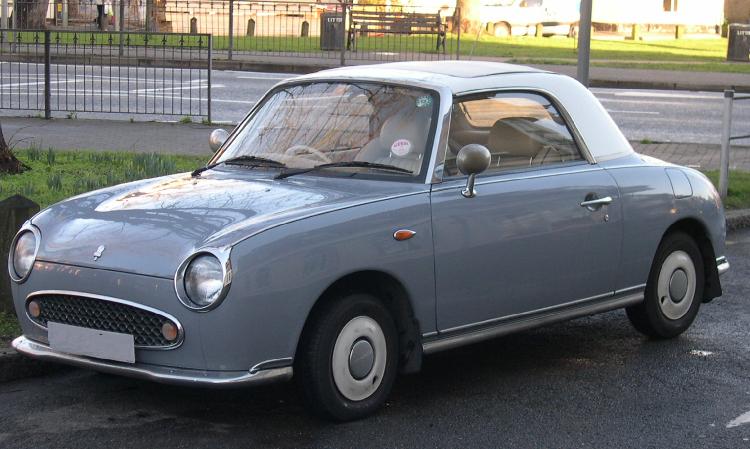
The front round turn signals were borrowed from the Nissan Figaro, although the color is amber to make distinctive. These lights were also later used in some 180SX models as well.

The Nissan Figaro. The resemblance is uncanny (not!)
from http://www.sillbeer.com/blog/entry/sweet-nissan-180sx-type-x-on-yahoo-japan-auctions/

Finally, what Shiraiwa wanted to do was to have an “S” mark inscribed in both the 32 and 33 headlights. (in the photo of the R30 headlamp below, you can see an “S” mark between the two lamps, at the top where the light doesn’t hit).

Next in R33 GT-R Design Trivia, Part 2: Emblem, Steering Wheel and Gauges

Friday, July 18, 2014

A New Type of Roll Center Adaptor

So I took a day off today as I had some errands to run and stopped by Do-Luck again as they are only 5 minutes away from where I live.
Looks clean as usual, right? Unfortunately not underneath!!
They have a new product which I've been interested in since its release a few months ago - their new roll center adjusters.  Actually, ever since I lowered my car by fitting the complete Nismo link set, I've studied, read up on, and been told that ideally the car should have some roll center adjusters.  I've been meaning to do so, but other stuff kept me distracted.  Here is a well written site which explains what they do, if you need a refresher like I did.

Moonface is probably the Japanese company best known for their roll center adaptors. Here is a photo of the kit for the BCNR33:

From: http://www.superlap.jp/item_detail/57/
Do-Luck has, however, recently helped in the development of this very interesting R33 GT-R which Dino has featured on Speedhunters:


And as you can see from this video, it is a very, very fast car (his time here at Fuji Speedway is about the same as a GT race car):


Anyway, this car runs Do-Lucks's new Roll Center Adaptors, available for the R32, R33 and R34 GT-Rs:


Which you can tell, by looking at the shape, are not your typical roll center adjuster/adaptor.  These work by not just restoring the angle of the lower arm (of a lowered car) to near horizontal/stock angles, but ALSO simultaneously work to restore the tie rods to their pre-lowered state.  In fact these may be the first ones on the market to combine roll center adjusters and tie rod ends into one piece.

Further, these are designed specifically for cars still running the OEM arms and OEM tie rods - in my case, I have the Nismo arm which is OEM shape but with stiffer bushes, and yes still the OEM tie rods. So perfect for my car!

Camber is increased another 1 degrees, and so with the Nismo links like me you end up with about 3.2 -3.5 degrees of camber.

Do-Luck offers these S7075 duralumin items in two colors - the anodized silver above, or anodized black. I went for the black, simply because I thought it would stand out from the rest of the suspension pieces.

For the left side, facing up
I actually took a bunch of photos as the install was happening, but having driven my car most recently in a rainstorm and not having properly washed the under carriage, I am choosing not to embarrass myself with how dirty the car was underneath!

But as I discovered, the install was not as easy as it could have been - maybe for a DIYer with the proper tools, it would be possible.  Basically, while it is obvious that the lower arm has to come off the hub, and the tie rod comes off of the hub piece as well, in my case, the brackets for the R35 Brembos meant that fitment was a bit tight - necessitating removal of the driveshaft to make sure everything was bolted up properly tight.  Then after it was all bolted and connected together, the alignment had to be redone as well.

Anyway - to get a better understanding of how and where it fits, here are some photos (and again, I am distraught about how dirty it is...)

Before (left side):
Looking from back to front - Circled in blue are the bits between which the Adjusters fit

After (Right side):
Looking from the front to back. Obviously the arm is not connected yet.

Looking from the front to back. Circled is the adaptor installed. Note lower arm is now connected.

Looking from back to front - you can see, circled in red, where the tie rod USED to be connected

View from the top - you can clearly see the tie rod is no longer connected directly to the knuckle

Driving Impression:

So after both sides were done, and the alignment fixed, I went for a spin.

The first thing I noticed was the steering felt lighter. Almost as if the power steering had gotten stronger, or the car itself lighter.   Ito-san told me this is because the tie rods are no longer in the "Y" shape, they are more parallel with the ground. In fact this is, if I recall correctly, how the car felt BEFORE I lowered it.

 I then noticed that the front wheels felt like they stuck to the road better because the car seemed to react a bit quicker than before, going left to right.  In other words, the car felt more "flickable."  Obviously, this is because the arms are also more parallel to the ground, and not doing the "Y" as can be seen in the Megan Racing link.

Finally, my biggest issue - on center numbness - seemed to have improved.  The zone (the angle of the steering wheel from left to on-center and then from on-center to right) over which the car feels relatively numb (remember I drove my friend's non-power steering NSX, which remains my personal benchmark) has shrunk substantially.  But dead on center, the feel can STILL be improved to be honest.

So I am one step closer to obtaining the kind of handling, both in feel and in response, I want with my car.  The more nimble handling (which I was told may actually make the car feel a bit jittery on bad roads), coupled with improved on center feel.

The only caveat I have is, these are expensive, with a retail price of 84,000 yen for the pair!  Perhaps I should have done some more research, but how much of an advantage do we gain by utilizing one solid piece vs corrections at both locations (by using roll center adjusters and tie rod ends)?  I guess one thing about high prices, however, is that likely not many people will have these on their car so it will add to the "bespoke" nature of my car.

So what do you all think? Post a comment and let me know! (and yes, I know, I'm still working on the R32 vs R33/R33 trivia blog posts...thanks for your patience on those!)


Wednesday, July 16, 2014

Best Motoring (Keiichi Tsuchiya) Review of the Series 3 GT-R vs. Impreza WRX vs. NSX 3.2

I'm still working on a bunch of posts on the R33 vs. R32 as well as some R33 trivia...in the meantime your patience is appreciated! 

I had found this video before (and posted it), but lost it when Best Motoring had it removed from YouTube.

But I stumbled upon it tonight, so while it lasts - and yeah the quality isn't great:
Part 1 (to about 8 min):


Tsuchiya reviews the then new Impreza WRX Type R Sti, vs the new 3.2 liter NSX, vs. the Series 3 R33 GT-R (non V-Spec).

Not surprisingly, he loves the NSX (engine power is nice, great brakes, very stable, easier to drive than the previous version), is impressed with the Impreza (very readable, like a well designed FR car).

Compared to older R33 GT-R models, he notes
1) the ABS braking is fantastically good (but the car is heavy... not surprising considering the other two cars)
2) Std car (not V-Spec) is more than enough if you're not always doing track days
3) Can really feel the front sticking to the road - this allows you to read how the rear is moving
4) Unfortunately he notes that the test car, without an oil cooler, shows the oil temp rising very quickly (by the 3rd lap)
5) Fastest of these 3 cars around this track.

In his summary comparison, the Drift King says that the car is significantly improved and of the three cars it's the most stable, and most confidence inspiring to drive at full speed. But yes the oil temp goes up too quickly, car should really have a large oil cooler for track running.

However, the brake balance, suspension balance, as you drive the feeling as its cornering, pointing it into corners, or stomping on the brakes, the GT-R had the best stability of the three.

What follows are a bunch of 0-400 runs, the results of which are obvious from viewing the video.

This second section begins by showing how turbo lag can really affect the GT-R's times (if the race begin at idle versus full revs, clutch drop).

The cars are then taken to Tsukuba for the famous Best Motoring "race" test. The results are again obvious if you view the video - with the lighter cars gaining an advantage over the GT-R.  Naoki Hattori complains that the brakes are weak, for such a heavy car.

Finally, whether those testers would buy each of the seven. Impressions of the GT-R:
Takuya Kurosawa points out that the car is on the edge of oversteer and understeer, depending on whether the turbo is spinning or not given partial throttle. That "delicious" neutral is hard to find and doesn't appear often.

Four of the testers would buy the GT-R; three would not.

Nakaya - (would not buy) If I were to get this, I'd get a V-Spec instead.
Tsuchiya - (who would buy it) retors - buy it on the premise you wouldn't take it to the track. You can have a family of 4 ride in it, no problem. And, a just a "bit" faster than most (family cars). I can't forgive it for being slower than an R32, but it's a "buy."

Ooi - (who would not buy says) Sure I'd buy it if I wanted to drive easy.
Nakaya -  then get a V-Spec.
Ooi - no, then the ride is too stiff.
Nakaya - well that's because the purpose is different.
Tsuchiya: So don't take it on the circuit, as a road car it's a good car!
Gan-san (who would buy): Yeah but the gas mileage is bad!
(everyone chuckles)

Aki comment: given how well known Tsuchiya did not like the R33 GT-R (he bought one after test driving a press car, which was fantastic. His personal car did not live up to that press car's performance after which his opinion soured), I am amazed he had relatively positive things to say about the GT-R.

Again, a few more days and I should be able to begin posting the posts which I have been conducing lots of research for.  Appreciate the patience!!

Friday, June 27, 2014

Fuse Tuning! (Yes Another Gimmicky Mod...Placebo effect?)

A few years ago, I read an article on "fuse tuning" in one of the many car /car parts magazines here in Japan.

The whole concept was basically an extension of using gold plated fuses to improve the sound quality in hi-fi stereo systems. (A Google search under "Fuse Tuning" will show a bunch of links on this.) The claim was that gold plated car fuses would enable the car's stereo to sound better, and the ECU to operate more accurately, etc.

But 24K Gold plated car fuses??!!   Just goes to show you that, with the proper marketing, car owners in Japan will try just about anything to extract just a bit more from their cars.  And yes that includes me, except I wasn’t about to spend 1050 yen per fuse(!)… imagine how much it would cost to replace ALL the fuses in your car?

However this concept seems to be a gimmick that quickly ran its course... still, the logic seems to be undeniable, we all see those gold plated stereo wires...

The leading company was called Ritz (which apparently now is out of business, surprise surprise) and had these types as well other types of these fuses:

From: http://www.geocities.jp/bigsingleworks/ritz.html

On this website that sold the Ritz fuses, they even have a dyno chart showing the before and after, and even better the car used was an R33 Skyline which shows a 0.5kg/m increase in torque, plus 18.7ps increase in HP!!

Apparently changing 10 fuses is all it takes!!

But 1000 yen per fuse?  Even back then, my cheapness won out…. However, just the other day, I stumbled on these very similar G-Fuses  (car fuses with 24 gold plated terminals from Amon, a popular car DIY company) on Yahoo Auctions – except now it was 490 yen for a pack of 10! So yes, couldn’t resist, although the fact that these are now clearance items tells you something…that in the end, even the Japanese consumers didn’t buy into the propaganda!

These aren't made anymore... and are listed as out of production on Amon's website here
According to some here in Japan, with the 33 in particular, having the battery located in the rear, plus the longest wheelbase (requiring the longest electrical harnesses and thus a drop off in the strength of the current) of the RB26 GT-Rs is the reason why, the 33 car tends to have electrical related problems - although I’ve never had a problem myself.  Then again, I’ve installed an earthing kit, and at the moment I’m not running electrical devices that would strain the system. However, in my quest to modernize the car, I suspect that it will require more electrical items to be added – thus if these G-Fuses provide any benefit at all, and they are cheap, then well worth installing them I think? Even the slightest benefit might help.

Let’s back up a bit – do a Google search, and you will see lots of debate on whether gold plating actually makes a difference.  The debate is particularly loud in the audio/video world:


The consensus though seems to be that gold, while not as conductive as copper or silver, does not corrode like they do, and also does not react with other metals.  Additionally, gold is malleable.  Thus, a malleable, non-corrosive and non-reactive metal (in the audio world, as gold plated terminals, speaker wire, etc.) appears to be the best way to improve electrical contact and thus connectivity.  People agree, however, that there should be no difference in sound quality.

So what would that mean for car fuses?
  
In most fuses, the metal used is zinc, copper, silver or aluminum, or an alloy of those metals. In car fuses, the metal most commonly used is likely zinc, for cost reasons.


So if you look at these G-Fuses, you can see that the terminal blades are plated (they claim) in 24K gold.  As a layman, I think that unless the entire fuse itself is made of gold, there won’t be any difference in conductivity of the entire fuse circuit, assuming that the metal part of the fuse is made of zinc overlaid with a thin layer of gold.

However, the packaging claims otherwise. 

For the 10A fuse, the company shows an improvement of about 2.7mmOhms difference in electrical contact resistance.  For 20A fuses, the difference is smaller.  So, like the audiophiles claimed, these fuses apparently improve electrical connectivity.

But would there be a difference in “sound quality” – in other words, would the improved electrical connectivity somehow improve the overall electrics of the car?

To answer this question, I found people’s impressions of these on Minkara (the Japanese all things car site):

To summarize, impressions are all over the place, some saying no change at all, others saying they feel a difference, etc.   The reality I believe is, if used in a simple, isolated circuit, you are more likely to detect a difference. But in a typical car, with hundreds of circuits and dozens of connectors (that don’t use gold), the likelihood of a single gold plated fuse making a noticeable difference, is slim.

Still, objectively I think these are “better” fuses than what is typically used.  So, let's try and see what happens?

First, the 20A fuse for the right headlight:

Before I switched the fuse for the RIGHT headlight

After: See the difference? Not really, yeah me too...

Ok how about the rear lights? 10A so maybe a bigger difference?

Before

After...I tried to stand in the same spot...a very slight difference? LOL

Conclusion: it's always smart to have extra fuses lying around, just in case, so IF you can buy these at a serious discount, then why not? Doesn't hurt, and in the off chance there actually is an objective difference, then great.  At the very least I can go around bragging about having gold plated fuses on my car now, lol!!


Thursday, June 12, 2014

Mini Aero Project - OK So That Didn't Work... What Was I Thinking?

So in my quest to modernize the car, in addition to mechanical and electrical items, I stumbled upon this:
Courtesy: http://parisworkingforart.wordpress.com/2010/06/06/lexus-lfa/
This is the driver side rear view mirror from the Lexus LFA - note it has the horizontal strakes built in, presumably to better manage airflow going around the car.  So I began to wonder if there might not be an easy to way to replicate this on one's existing mirror?

I found this:

From the manufacturer's description, this appears to be just what I was looking for!

Apparently, with the strategic application of these double stick tape rubber pieces, you can straighten out the flow of air around your car, and in the process, reduce wind noise!

For less than US$8.50 (JPY 830), this was too good not to try.

So while June is rainy season in Japan, on a sunny day I broke out the can of KR4 spray paint (which I still have left over from the fluidic nozzle mod) and spray painted the two pieces for the mirror in the hopes that they would blend in fairly decently.


Then on a trip to Chiba prefecture just today (to implement Step 1 of my long awaited audio upgrade... stay tuned, pun intended) I had the opportunity to try these pieces out.  Mounting was as simple of finding a place to put them, peeling off the double stick tape, and sticking them on:

On the B Pillar

This was the only place this piece would stick on the door sail

You can see the knob sticking out off the bottom of the mirror

And then it was a matter of driving to see what the difference was.

The verdict?

Uh... well... I could NOT tell the difference - not because these don't work - maybe they do - but because the road noise and engine noise coming in from the firewall area, plus the sound of the exhaust, basically made it too loud for me to hear any wind noise. For my audio upgrade, while I did lay down sound deadening as well as undercoating looks like I will have to do the firewall...

I even drove (a bit ?? lol) over the speed limit, in the hopes that at really fast speed wind noise would be more apparent - but no difference.  The only thing I DID notice, however, was that my BNR34 rear diffuser was working quite nicely - sending up a rooster tail of water at speed (it was raining quite hard by the time I was driving back home today).

Thankfully, again this aero mod cost me less than 850 yen to try.... maybe I can find a Prius to try it out on...