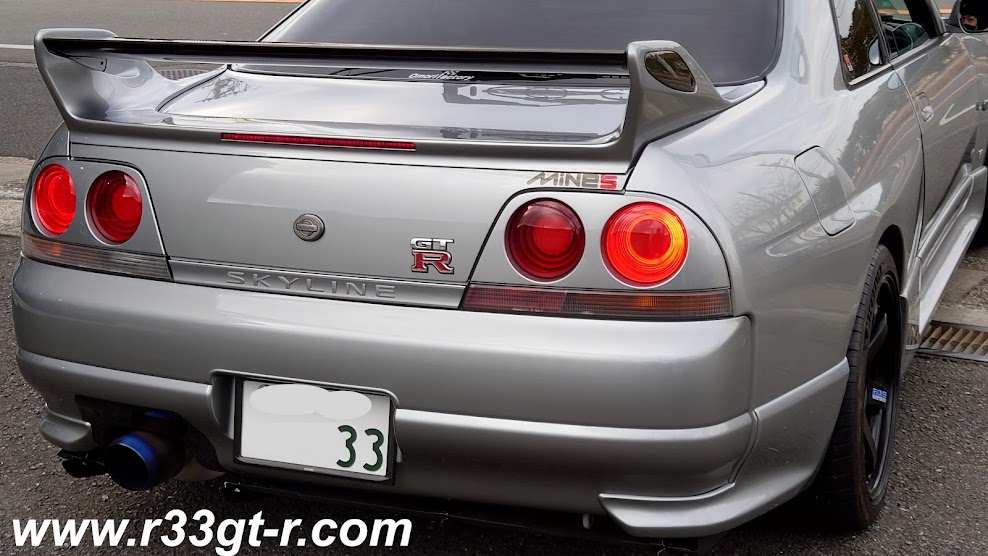
So recently my friend and fellow R33 GT-R fanatic Thomas Mangum
invited me to drive his Midnight Purple machine. I jumped at the chance – it would be a rare
opportunity to drive a high spec car (and one with the
HKS V Cam, too!) and compare against mine.
When I pulled up to his house, I initially took some photos
before jumping into the driver’s seat.
Thomas seemed embarrassed by how dirty his car was, but that couldn’t be
helped as it’s parked outside and as a daily driver a car cover doesn’t make
sense (for most people...). Nevertheless the car was in good
shape, nothing a nice wash and wax wouldn’t fix.
 |
Purple disc rotor caps to match the Midnight Purple car. Nice touch. F50 Brembos with Biot 2 piece rotors!
Wheels are ENKEI RS05RR in 18x11J(!!!) with offset of 16.
A bit of trivia about these wheels - these were one of, if not THE first, sets of the RS055RR that Enkei made for the Skyline GT-Rs. How do we know? Because when Thomas and I went to Tokyo Auto Salon that year, we noticed that the displayed wheels had some stickers that these wheels did not have. When we inquired, we were told that the first batch did not have the stickers, and further all the ENKEI reps there said they had never seen or known of a GT-R with them before! (ENKEI later mailed him the missing stickers!)
|
 |
| Essentially this is a custom made front bumper - I've never seen another quite like this. |
I recall when Thomas asked me if I had ever seen this front bumper before when it came up for sale on Yahoo Auctions a few years back... obviously the answer was no. It seems to be a very clever design, incorporating cooling abilities along with the front canard aerodynamic effect. It apparently was a one-off design for one of the
JUN Auto racing cars [thanks to our friend Matt Rearick who remembered seeing the same item on Yahoo, and the description!] which meant that Thomas had to get clever to incorporate turn signals in order to make it street legal.
I'm proud to say I did my bit to contribute to this engine, as the fuse box cover was something I gave Thomas a long time ago... Note also the relocated power steering pump fluid reservoir.
 |
| Aha! V Cam. I can only dream at this point. With a NISMO surge tank too! |
Yep. I was eagerly looking forward to how differently this car would drive with the V Cam, given the
HKS 2530kai turbos the car is running.
 |
| Carbon fiber hood (or bonnet in the Commonwealth?) |
He has some interesting custom mods so I took photos of those. For example:
 |
| Custom carbon piece to direct air towards the intercooler. If well done, stuff like this adds to a car's allure and personality. |
I've already pointed out the clever use of side turn signals used upfront. Here's another custom application:
 |
| Another interesting tidbit - oil cooler located here! |
Due to the design of the bumper, Thomas couldn't place an engine oil cooler in the usual place (that is, under the left front lights in the front bumper). So naturally, he put this
Greddy one up front behind the grill to ensure lots of airflow. Reminds me of the old NISMO set up (albeit that was underneath and behind the front lip spoiler).
Speaking of spoilers:
 |
| Genuine NISMO dry carbon 2 piece blade. Looks like the previous owner liked to advertise that fact. |
For the back, he found a used NISMO 2 piece dry carbon spoiler blade. He restored it best he could but you can still make out where someone had applied a NISMO sticker. (and yes, the blue car in the back ground is the
ISF I'm slowly modifying...lol)
 |
| 90mm AMUSE titanium exhaust. |
Thomas' car is equipped with this
Amuse R1 titanium exhaust, which obviously maximizes exhaust flow and doesn't even pretend to really have any "muffling" capacities. This thing is LOUD!
Thomas later sent me a list of the specs of his car. For example, some highlights of the engine/powertrain are:
- N1 block bored to 86.5, N1 oil pump, N1 water pump
- Carrillo rods, Mahle pistons (both save weight)
-
balanced and straightened crank by NAPREC
- NISMO crank and conrod bearings
- NAPREC
high response head kit (ported, etc.)
- NISMO 600cc injectors/NISMO fuel pump
- R35 AFMs
- Tomei Powered
oil pan baffle/metal head gasket (1.2mm)/timing belt
-
Trust/Greddy Type R intercooler
-
Okada Plasma Direct ignition coils
- HKS hard piping kit
-
Advance 130A alternator
This is all managed by a custom flashed ROM that piggybacks on top of the OEM ECU. Thomas estimates about 600 horsepower.
So how does this all add up, really? I’ll give my honest (good and bad) impressions on how
the car drove, as well as photos of some interesting interior bits, in my next post...