Showing posts with label aerodynamics. Show all posts

Saturday, July 20, 2019

A Very Important R33 GT-R (for R34 GT-R fans)

Wow how time flies - one month since my last post!

As I've told NISMO to take their time with checking over my car, no real updates that I can talk about here. Hopefully soon...

In the meantime, I recently had an opportunity to drive my other car up to the Prince & Skyline Museum up in Nagano.  I will do a full blog post on the history of Prince Motors, the Skyline, and the cars in this museum, but there was one car that I felt deserves special attention. The R34 GT-R development car.
At first glance a BCNR33 with Series 3 headlights and matte black paint...
 With an official name of "Stealth," many Nissan test drivers at the time instead chose to call it the "Karasu" (the Crow). Note, here in Japan the indigenous crows are known for being supremely intelligent birds that not only remember people's faces, but will later attack/purposely drop stuff (their crap... seriously!) on people that have messed with them in the past. And they are large birds, very intimidating... so not sure if the nickname was good or bad...

Anyway, back to this car.

 Here is what it says:

R34 GT-R Development Car
Objective of testing: This car was constructed for the main purpose of evaluating aerodynamics
Specs:                 Base car is R33 GT-R V-Spec
                            Installation of Front Diffuser (Dry carbon construction)
                            Installation of Rear Diffuser (Dry carbon construction)
                            Changed Rear spoiler to R34 equivalent (height, angle, etc.)
                            Changed Tires to 245/40ZR18
                            Strengthened rigidity inside the rear fenders and rear pillars
Testing period: Around 1996-97. Mainly in Tochigi, and extreme test runs at the Hokkaido testing grounds

Behind the Scenes:   While this car was officially nicknamed the "Stealth" most of the test drivers at the time lovingly called it the "Karasu."

Let's take a closer look at some of the items listed:

I guess they decided on the 34's 18 inch wheel design fairly early 
In this photo, I was checking to see if the brakes were special. They don't appear to be. On the other hand, those lug nuts look weird...

Ok so let's check out the front diffuser. The car is wearing a Series 1/2 front lip spoiler, with the one piece dry carbon diffuser attached underneath.

I'm guessing the rivets on the side are for a bracket of some kind to attach the carbon diffuser. The tape appeared to be covering some damage.

Here, you can see some obvious curb damage - but you can also see that the diffuser extends back to the rear of the oil pan.

Here you can see how the front outlet on the diffuser extends to air in the back. Also, they've used what appears to be flexible black tubing used to cover wires to cover up the cuts made to the lip spoiler and the diffuser.
Can anyone make out what it says there?
Obviously, the car was jacked up quite a bit. And someone messed up at least once.
Exhaust looked pretty normal and OEM - makes sense as they weren't trying to improve power.  Also, you can see how far back the front diffuser extends.
 Ok and what about the rear diffuser?
Looks pretty boring...standard muffler too...
But when you take a closer look - the fins are different front to back.
Inside ones get taller towards the back, while outside ones taper off.
Looks like they just cut around the muffler. No need for the clean finished look. 
And here is a close up of the rear spoiler. Looks like they simply raised the OEM BCNR33 one, to be honest.
yeah, that 34 in the back... see below
 For me the most interesting improvement were those made to the C pillar and rear fenders.
In the 34s, the rear C pillars have foam that hardens- in this car, looks like maybe a plate or something was welded in place?
 Here is a better shot, you can see both weld lines clearly.
Any readers with welding expertise? What would these lines suggest to you?
Incidentally, I DID take a look inside the car, and found it to be a very normal car with the Series 2 interior.

And finally, here is one for the 34 fans. This is the car you can blame for not beating the 33's sub 8 minute Nurburgring lap time.

The description talks about how the R33 was fast enough but they wanted to make the R34 easier to drive - which is consistent with articles on the issue as I've covered before (you can also see photos of this same 34).
No excuses given as to why it wasn't faster than the 33. What is interesting is the claim that testing of improvements to be included in the next GT-R began 6 months after the 1995 R33 GT-R was released - my guess is this is where the trunk bracing for the Series 3 came about.  Apparently the objective was to beat the 33 by 10 seconds, but since Nissan didn't release any numbers, the public will never know the truth.  Of course, no doubt some diehard 34 fans will take this to mean that the 34 must have beaten the 33 by up to 10 seconds (but not more so Nissan couldn't announce) but of course they can dream on...

In the meantime, they should thank the Karasu 33 V-Spec for contributing to the improvements made on the 34.  In any case, a very interesting car that belongs to be better recognized for its contributions to the GT-R, both the 33 and the 34.

Check in again soon, I have a few dozen photos of the rest of the cars in the museum I will be uploading very soon!

Sunday, June 9, 2019

Real Life History: The Nurburgring Car in the Flesh!!

So anyone who's an R33 GT-R fan knows that the 33 was the first production car to lap the infamous Nurburgring in under 8 minutes - 7'59" to be precise. (FYI, the BNR32 did so in 8'20" but it was a struggle with the car understeering heavily and the brakes not up to par...)

As a result of the 7'59" lap time, Nissan engaged in a media campaign which highlighted this 21 second difference, starting with this TV commercial:


And here is the promotional video that was shown at Nissan dealerships all around the country when the car went on sale:


I've never been interested in any of the pre-production GT-Rs, 33 or otherwise, until now.  That's because this week at the Nissan Gallery at Nissan's Global Headquarters, I spotted this being displayed (cars that are stored in the Nissan Heritage Collection at Zama are rotated on a 2-3 week basis):

Initially, I have to admit I was more interested in the Z31 - haven't seen one since I was a teenager back in the USA.
 I thought the 33 was just another AL0 silver R33 GT-R...
But wait a minute - what's up with the red brake lamp in the bumper??
That's when I decided to read the plaque up front and...
HOLY TOLEDO!

So this is the ACTUAL CAR that did the 7'59"!! Factory test car, chassis number 000055!

I posted these photos to my Facebook account, and I think some of my R33 Facebook friends were just as excited - some of them were asking for more close up photos... so I went back down later and took the following. (Note, I did NOT open any doors or step over the barriers - hey I follow the rules!)

You can make out the padded rollcage showing in the left A pillar and front of the roof lining.
Better view of the rollcage - and barely used seats. Note the degradation of the door rubber though.

Best view of the rollcage set-up
Ok but I also heard rumors of other mods other than just body rigidity improvements (plus a cage would be needed presumably if they crashed on the track so it makes sense from that perspective too). So I walked around to see what I could find. Obviously not allowed to pop the hood, but I have an idea for that in the future...

Brakes look like the OEM 4 pot Brembo calipers

Note how the caliper paint looks messed up, as if they spilled too much brake fluid when bleeding the brakes. However the Brembo logo is still white, which means the caliper didn't get as hot as I had on my car - better driving by the pros probably lol.
Underneath the car - I did look under the FRONT side as well, but it looked very OEM. The rear underside, however, was interesting:

Note the oil cooler on the right

And this exhaust. Looks OEM - 2 pipe muffler, but from the down pipe to the muffler itself that looks like about 90mm...!

And what about mileage? How much has this car run?
Oh, the 300km Speedometer is interesting...

10,416 kms!
And if you look closely, looks like they installed extra padding for the driver's left knee and right knees. Check out this post and you will see it.

Anyway, I'm still curious about what other mods this car had. From what I could see, looked pretty stock except the exhaust pipe suggests not all is stock in the powertrain. Maybe a personal visit to the Heritage Collection is in order soon.

Meanwhile - here are a few more photos for Z31 fans. Pretty cool car, considering at the time it was sold I thought it was a bloated, tech loaded and slow car.
That turbo scoop and pop up lights are pure awesome!

T-Roof, leather seats... and auto transmission. Yeah, rich housewife's car
Please, someone tell me what this "Bodysonic Amplifier" is!!!

Actually, thanks to Mr. Google I know what this is. Very cool feature! Ah, the 80s....

PS - I found an article about Gan-san and his trip around the Nurburgring in a 33...enjoy!

Monday, April 13, 2015

Update - Protection for the Series 3 Front Lip Spoiler

One of the biggest problems, actually, with the Series 3 R33 GT-R (vs. Series 1 and Series 2) is the longer front lip spoiler.  Yes, it looks great, but it scrapes everywhere! (and it doesn't do much until you hit expressway speeds too...)

This OEM piece is made of ABS plastic (and came unpainted in its original black color), so it will not crack when the inevitable scrape happens - and by the way most of the time it's in those vertical parking lots (common in Japan) which require you to drive up, up, up to a parking spot... and then down, down, down to exit, at relatively steep angles, where your spoiler kisses the ground each time the ramp transitions from angled to flat, usually as you turn a 90 degree corner.

Series 3 kept by Nissan, showing the larger front lip spoiler, black ABS plastic
(Note this car also has the optional and now rare oil cooler kit with extra ducting in front bumper)
As a result, I absolutely hate driving my car to go to places like IKEA or Costco, where the parking lots are designed to pack as many cars into a small area as possible (I would even prefer mechanized parking over this, but I don't see those often, and sometimes my car is deemed too low to park in those pallets too...argh).

Anyway, once I got my front lip spoiler painted, I decided to get more creative to protect it.  Previously, I had tried to install a (Nismo) rubber strip that ran all the way across, and when that quickly peeled off (despite being bolted and glued on), I then tried thin aluminum strips which I bolted and glued on.  These also came off, and even got caught up under the car, causing a scratching noise that resulted in some pedestrians pointing and staring...

In any case, I had given up on this kind of extra protection, when I had a brainstorm.   My most recent effort involves rubber stoppers and some stainless screws which I found at my local hardware store:

To summarize, I simply used the same mounting points for the front diffuser using the pre-existing holes in the lip spoiler.   At each point, I lined up a rubber stopper and used an extra long screw to use the pre-existing holes.  When done, the underside of the front lip ended up looking like this:


But this was back in October of 2013!  Quite frankly (and yes I don't drive this car that much) I had forgotten about these, although the couple of times I recall scraping the front, I remember thinking "I wonder how those rubber stoppers are working? Oh well..."

Today however, I had a chance to look underneath when doing a minor project (to be posted soon), and found this:

The lip spoiler still looks good (ok it's dirty) but these rubber pieces worked as designed!  That is, they sacrificed themselves by being the lowest point on the front lip, hitting the ground/road first, and obviously lifting the lip out of danger's way!

So yay! Finally something that works.  Oh, and as for what I was doing working on my car, check back in a few days...

Monday, October 6, 2014

How The R33 GT-R Improved Upon The R32 GT-R (Part 1 - Exterior Design/Aerodynamics & the "High Traction Layout")


So although I've previously explored the differences between the R33 and R34 GT-Rs, and discovered that while the running gear basically stayed the same, with improvements to body rigidity and aerodynamics (as well as styling, of course) being the main differences, I hadn't yet really looked into the differences and improvements between the R32 and the R33 GT-Rs.

Nissan had a problem - the R32 GT-R was spectacularly successful - and its successor the R33 was bound to be in its shadow unless it was substantially better both subjectively and objectively.  While R33 haters may not like to admit it, the R33 GT-R is a technically much improved car over the R32 GT-R - so much so, if you recall the objective when designing the R34 GT-R, Nissan's goals were not to make it any faster than the R33 (it was deemed fast enough), but rather, just easier to drive for the average driver.

In any case, with all the information I found, I've split the discussion into two parts - this post, Part 1, which examines the improvements in the exterior  (design and aerodynamics) and the "High Traction Layout" (balance and body rigidity), and the next post, Part 2, which examines the Engine, ATTESA ETS PRO, and Super HICAS.

Exterior Design and Aerodynamics:

When development of the R33 (the general model, NOT the GT-R) began, it was initially conceived that the 2 door coupe would ride on a shorter wheelbase than the 4 door sedan. The coupe was to have a shorter hood as well (further, no turbo model was contemplated).  This all changed, however, when Nissan decided to put the coupe on the same wheelbase as the sedan.

We all know that the R32 GT-R excelled in the Group A racing series in Japan. However, the R33 GT-R was facing a different race series (N1 Taikyu), this one which required sustained speeds exceeding 250kph; this requires not just awesome acceleration but stable braking prowess as well.  Thus, Nissan decided to put heavy emphasis on aerodynamics during the design; and not just better aerodynamics, but balanced aerodynamics.

The R32 was developed with the “Zero Lift” concept in mind, hence it sported a large rear spoiler to help keep the car on the ground and provide stability in high speed cornering.  However, its coefficient of drag was 0.40, which was not something to brag about even back then.  Further, based on racing experience Nissan wanted the R33 GT-R to have superlative cooling and anti heat abilities, which would require large openings for the radiator and oil cooler.  The front spoiler would have to be a shape which would reduce front lift as well.

Nissan called the design theme for the R33 GT-R,  "Sophisticated Strength" -  while engineers wanted superior aerodynamics, cooling ability, and a wider tread, the designers wanted a design that suggested speed and power.

Here are some quotes on various design aspects from the chief of the GT-R’s exterior design, Hidetoshi Nishiizumi: (Source: Cartop Mook: R33 Skyline GT-R Best Album) (all Nissan Gallery photos from Wikipedia)


"The R32 had excessive front lift.  At Fuji Speedway, taking the high speed 130R corner at speed was scary, according to Kaz Mizuno (later father of the R35 GT-R). So efforts were made in the R33 to minimize front lift - and in that regard, the longer front overhang worked in our favor."


"We designed large openings in the front bumper, and made the shape spoiler-like. We experimented with various angles for the lip spoiler as well, to get the best wake separation for the air.”


“The size and height of the rear spoiler of the R32 GT-R were designed with Group A racing in mind. The regulations meant the wing could not be adjustable, so we put a big one on from the beginning.   The R33 GT-R had an adjustable one.  From the rear, you can see that it actually has a “Y” shape design.  Mizuno-san was heavily involved in the design.   Although it extends a total of 30mm on the sides, the size of the spoiler is limited.  We did experiment with a spoiler that would fit within the width of the trunk lid, but it looked unbalanced.   This is what lead to the current design with its overhang.”


“Compared to the R32 GT-R, what really gives the 33 remarkable presence is the larger spoiler on the back.  From the back, it really enhances its presence.  The reason we included an adjusting tool in the tool kit was so that the wing could be adjusted for track days – but in town, it looks best at horizontal.”

“We experimented with making the entire wing adjustable, but in the end settled only on angle adjustability and the caps on the sides, for weight purposes.  Also the reason why the rear is solid, but the front of the blade is adjustable, is just in case it became separated, it would move in the direction of generating downforce, allowing the driver to stop safely.”

The design was in a state of change until right before the car went on sale. You can see that the production car looks far more aggressive than the the prototype:
“Compared to the prototype, we widened the lower half of the body to give the appearance of a lower center of gravity.”
The R33 GT-R Proto - I'm not sure I see the narrower lower belt line?
Photo from http://www.gtr-world.com
You can see the solid, fixed position rear wing which has evolved from the Type M wing but is still not adjustable
Photo from http://www.gtr-world.com
Initially this rear trunk spoiler was a fixed position one, but at the very last minute a decision was made to go with the adjustable one we have now.  Incidentally, the original fixed spoiler design can now be found on the R33 GTS25t Type M.
The R33 GT-R could have had this rear spoiler design.
Courtesy: http://asteriskblog.blog90.fc2.com/blog-entry-39.html
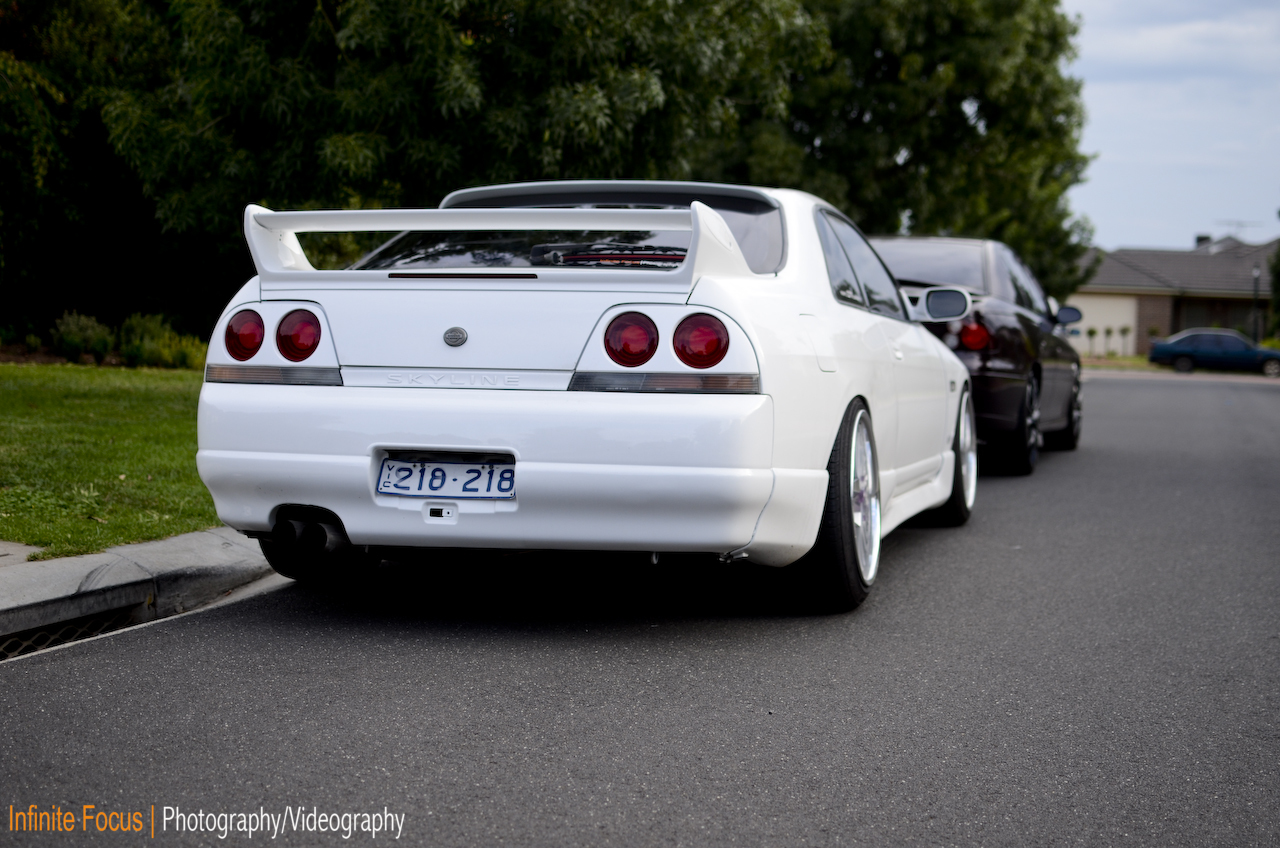
Also, one aero design that was considered at the time, was to have a roof spoiler in addition to the rear trunk spoiler.
GT-R could have looked like this, with the roof spoiler!
From: http://infinitefocusphoto.wordpress.com/2011/12/19/hangs-muskis/

There was extensive wind tunnel and road testing of the design, with efforts made to obtain the best front-back lift balance while allowing for wide tires, blister fenders and rear spoiler.  In the end the Cd equaled 0.35 (beating the R32's 0.40), and the front /rear downforce was better balanced, with a front coefficient of lift of 0.09, and a rear downforce of 0.03 (with the spoiler at the flat position). Even with the bigger body.

For a review, see this post

The "High Traction Layout":

In addition to the aerodynamics, the High Traction Layout improved the dynamic performance of the chassis.  This is Nissan's terminology for the technical chassis design differences which were designed to improve the performance of the R33 GT-R over the R32.  In addition to the improved aerodynamics, the High Traction Layout improved the dynamic performance of the chassis.  It did this by improvements in two areas: body rigidity and weight distribution.

Body Rigidity:
With the addition of front and rear strut tower bars, as well as adding cross bars under the floor in over 30 locations, rigidity was improved – 40% increase compared to the R33 GTS, and over 150% (1.5 times) more rigid than the R32. The improvements include, front tower bar, front cross bar (which connects the sides of the transmission tunnel), floor cross bar, the seat back center (the plate behind the rear seats), rear strut bar, etc.

From: "All About the New Skyline GT-R"
Four wheel multi-link suspension: The front layout was changed.  The R32’s weak point was the use of an “I” shaped upper arm, which was susceptible to rattles.   These were changed to “A” arms, which gave 90% more lateral rigidity. 

In the rear, Nissan added the “triple cross bar” – which adds more rigidity for the suspension members (in the R34, it also provided a nice place to hang the rear carbon diffuser off of… the 33 and 34 triple cross bar is the same, incidentally).

Having increased body rigidity means, of course, that power not only gets to the ground more directly, but the suspension behaves more accurately.  To the driver, this makes the car feel more nimble and agile, with more direct feel, and thus easier to drive.

Weight Distribution:

The Problem:  The R32 GT-R was criticized as being too front heavy, which lead to strong understeer.  Additionally, the fuel tank was placed below the trunk floor, meaning that there was weight overhang in the rear as well. Not only was the weight BEHIND the rear wheels an issue, but as fuel was consumed and the rear got lighter, there was an obvious effect on the car’s performance.  Combined with a less rigid body, the R32's potential was wasted.

The Solution: With the increased wheelbase, it was now possible to improve weight distribution; the plastic fuel tank was placed below the rear seats, battery moved to the trunk, and to the extent possible, heavy things were moved towards the center of the car.  The front and rear overhang weights were lightened.

 From: "All About the New Skyline GT-R"
But improving the weight distribution wasn't just about moving things around between the wheels - it also means reducing weight in critical areas to improve the balance of the car.  The increased body rigidity didn't help - the added bracing added to the car's weight, which meant that Nissan engineers had two compelling reasons to try to figure out ways to lighten the car.

Up front, to reduce front overhang weight, the front hood and fenders were made of aluminum (as in the BNR32), the headlights were made of lightweight plastic and the intercooler was lightened, in order to lighten the front overhang, reducing inertia.  The intercoolers were changed from extruded multi hole tube to inner fin type which improved response, cooled 4% better, and was 400g lighter.

Nissan engineers also found other ways to reduce weight, even by a few grams.
This includes:
Hollowing out the side door beams.
Using high tensile steel on body panels.
Reduction in sound deadening materials.
Super HICAS becoming electric.
Hollowing out of rear stabilizer bar.
Use of high tensile springs front and rear.
Shrinking the ABS actuator.
Light aluminum wheels with higher rigidity
The front and rear axles were made of aluminum (as in the BNR32) but also so were engine mount insulators and brackets
New plastics were used for : fuel tank, head lamps, super high strength "PP" bumpers, air cleaner, changing the headlining material, changing material of rear spoiler.

So even though the R33 was heavier by 100kg, the records show that it was 30kg heavier up front, and 70 kg heavier in the rear.

There were a few drawbacks to the High Traction Layout, however - although these were deemed worthy sacrifices to get better performance:

1) With the battery moved to the back, as well as the rear strut bar, trunk space and volume is smaller on the R33 vs the R32.
2)  Additionally, the fuel tank shrank from 72 liters to 65 liters… resulting in a lower range.

In any case, I think they did a great job on both the looks, aero and chassis development.  It is ironic that people criticize the longer wheelbase without understanding how Nissan engineers actually used that to the car's advantage from a dynamic technical standpoint - the longer wheel base is not just stability at speed in a straight line, but also with the High Traction Layout in corners too!

Next: Engine, ATTESA E-TS PRO, and SUPER HICAS

Sources:
1) Cartop Mook: R33 Skyline GT-R Best Album
2) Neko Mook: I Love R33 Skyline GT-R
3) Motorfan: 新型スカイラインGT-Rのすべて("All About the new Skyline GT-R")