Showing posts with label Okada PlasmaDirects. Show all posts

Sunday, February 7, 2016

Thomas Mangum's Midnight Purple R33 GT-R - Spec Check and Driving Impression! (Part 1)

So recently my friend and fellow R33 GT-R fanatic Thomas Mangum invited me to drive his Midnight Purple machine.  I jumped at the chance – it would be a rare opportunity to drive a high spec car (and one with the HKS V Cam, too!) and compare against mine. 

When I pulled up to his house, I initially took some photos before jumping into the driver’s seat.   Thomas seemed embarrassed by how dirty his car was, but that couldn’t be helped as it’s parked outside and as a daily driver a car cover doesn’t make sense (for most people...).   Nevertheless the car was in good shape, nothing a nice wash and wax wouldn’t fix.

Purple disc rotor caps to match the Midnight Purple car. Nice touch. F50 Brembos with Biot 2 piece rotors!
Wheels are ENKEI RS05RR in 18x11J(!!!) with offset of 16.

A bit of trivia about these wheels - these were one of, if not THE first, sets of the RS055RR that Enkei made for the Skyline GT-Rs. How do we know? Because when Thomas and I went to Tokyo Auto Salon  that year, we noticed that the displayed wheels had some stickers that these wheels did not have. When we inquired, we were told that the first batch did not have the stickers, and further all the ENKEI reps there said they had never seen or known of a GT-R with them before! (ENKEI later mailed him the missing stickers!)
Essentially this is a custom made front bumper - I've never seen another quite like this.
I recall when Thomas asked me if I had ever seen this front bumper before when it came up for sale on Yahoo Auctions a few years back... obviously the answer was no. It seems to be a very clever design, incorporating cooling abilities along with the front canard aerodynamic effect.  It apparently was a one-off design for one of the JUN Auto racing cars [thanks to our friend Matt Rearick who remembered seeing the same item on Yahoo, and the description!] which meant that Thomas had to get clever to incorporate turn signals in order to make it street legal.

AutoSelect Tower Bar. ARC Cooling panel (no longer made).
Aluminum catch tank and UK GTROC Aluminum fuse box cover
I'm proud to say I did my bit to contribute to this engine, as the fuse box cover was something I gave Thomas a long time ago... Note also the relocated power steering pump fluid reservoir.

Aha! V Cam. I can only dream at this point. With a NISMO surge tank too!
Yep. I was eagerly looking forward to how differently this car would drive with the V Cam, given the HKS 2530kai turbos the car is running.

Carbon fiber hood (or bonnet in the Commonwealth?)
He has some interesting custom mods so I took photos of those. For example:
Custom carbon piece to direct air towards the intercooler. If well done, stuff like this adds to a car's allure and personality.
I've already pointed out the clever use of side turn signals used upfront. Here's another custom application:
Another interesting tidbit - oil cooler located here!
Due to the design of the bumper, Thomas couldn't place an engine oil cooler in the usual place (that is, under the left front lights in the front bumper). So naturally, he put this Greddy one up front behind the grill to ensure lots of airflow. Reminds me of the old NISMO set up (albeit that was underneath and behind the front lip spoiler).

Speaking of spoilers:
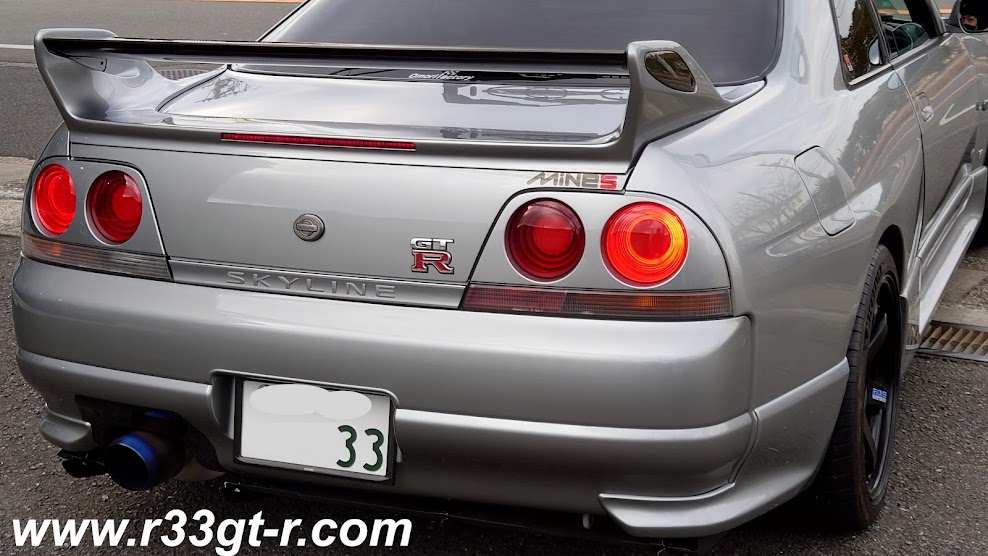
Genuine NISMO dry carbon 2 piece blade. Looks like the previous owner liked to advertise that fact.
For the back, he found a used NISMO 2 piece dry carbon spoiler blade.  He restored it best he could but you can still make out where someone had applied a NISMO sticker. (and yes, the blue car in the back ground is the ISF I'm slowly modifying...lol)

90mm AMUSE titanium exhaust. 
Thomas' car is equipped with this Amuse R1 titanium exhaust, which obviously maximizes exhaust flow and doesn't even pretend to really have any "muffling" capacities. This thing is LOUD!

Thomas later sent me a list of the specs of his car. For example, some highlights of the engine/powertrain are:
- N1 block bored to 86.5, N1 oil pump, N1 water pump
- Carrillo rods, Mahle pistons (both save weight)
- balanced and straightened crank by NAPREC
- NISMO crank and conrod bearings
- NAPREC high response head kit (ported, etc.)
- NISMO 600cc injectors/NISMO fuel pump
- R35 AFMs
- Tomei Powered oil pan baffle/metal head gasket (1.2mm)/timing belt
- Trust/Greddy Type R intercooler
- Okada Plasma Direct ignition coils
- HKS hard piping kit
- Advance 130A alternator

This is all managed by a custom flashed ROM that piggybacks on top of the OEM ECU. Thomas estimates about 600 horsepower. 

So how does this all add up, really? I’ll give my honest (good and bad) impressions on how the car drove, as well as photos of some interesting interior bits, in my next post...

Monday, December 31, 2012

Last Post of the Year (Really)!


Friends, on this last day of 2012, I am looking back and thinking about many things that I experienced this year. But mostly, how precious life is, how limited our time on this Earth is, and how important it is not to waste, or at least try not waste, a single moment of that time.  I hope we all can take a few minutes to reflect a bit on what 2012 meant to us, and how we hope 2013 will turn out to be.

With respect to this blog, I am always thrilled when people write to me with their comments – both good, bad, and constructive – or refer to this blog on internet forums and such - so thank you.  To get feedback when all I'm really doing is documenting my adventures with my car, is amazing. So thank you everyone who has spent time and energy reading this blog, and especially those who took even more time to leave comments.  I do have in mind some more interesting projects for 2013 and beyond, so please continue to visit here on occasion. 

Anyway… I hadn’t planned on being philosophical and this IS a car blog, so let me get back to business.
As I stated in my last post, I had taken my car to RAPT for some year end tweaks. Not only did Kabe-san finish early (I picked up the car Saturday, the only day recently it hasn’t rained!) but I am happy to report the car looks amazing.  That write up and the photos I will do in the new year, so stay tuned.  What really made me happy, however, is that Kabe-san noticed that my car wasn’t starting up as smoothly as he thought it should.  So, he did a bit of checking, and noticed that my spark plugs looked like this:
Now THAT is carbon buildup!!!
Yes folks, I will admit – I had not changed the plugs since I had the new engine put in at MINE’S, over 5 years and almost 30,000 kms ago! (then again, ONLY 30,000 kms? Huh?)

So what to do? Some quick research and I found out that NGK was preferred over Denso, and that there were mixed reviews on iridium vs. platinum.   And at this time of year, all the shops are closed, and ordering on the internet wasn’t going to get me new plugs anytime soon.  Oh, and naturally, I also looked at the Nismo website to see what they had, and yes they had Nismo branded NGKplugs… of course with the usual 200+% Nismo mark-up… ouch.

Luckily for me, Kabe-san has a few contacts at Trust/Greddy, and guess what. They ALSO carry NGK spark plugs – and without the huge markup (supposedly because Trust ordered a huge batch before there was a sharp increase in platinum prices…)  So anyway, these are what I now have in my car – their top of the line racing plugs, in #8 heat range:
Of course I paid much less than retail, too! 
The difference is very noticeable, the engine starts up easier, and actually sounds different (feels a bit smoother too).  So I’m pretty happy with the result.

As an aside, long time readers may remember these:
Thin copper washers in various thicknesses
The theory here is called “indexing” spark plugs – that is, using the washers to make sure that when screwed in, the plugs all end up facing the same direction – so the gap in each spark plug is aligned with the intake side of the cylinder head… the reason being that the electrode then doesn’t get in the way of preventing maximum spark/ air-gas interaction and thus the best possible combustion.  But now that I have the Okada Projects Plasma Directs installed, I don’t think it matters that much anymore, so I probably won’t re-visit this mod.

So anyway, just a reminder to everyone  out there doing beginning of the year maintenance – don’t forget the obvious!

Be safe, and I'll see everyone in 2013!

Wednesday, November 28, 2012

Interim Post – Some Recent Random Observations

Gentle readers, as I finally had a day off from work (national holiday today when I wrote this - Friday the 24th), I just wanted to post a few recent thoughts and observations involving my car that I had as they are all on scattered topics (not worth writing about alone), all in one writing.

Remember this install? The Nagisa auto brace:

While I was able to feel a difference immediately, I assumed that this type of brace was used only on older cars that were probably designed before automakers had access to supercomputers and hence could be improved upon with a simple bolt on.  But look at this, which I recently found in a current model year catalog for the Lexus GS cars:

Yes that’s right – an almost identical brace, in the same location! Presumably, supercomputers also agree that an efficient way to improve body rigidity even in today’s cars is by way of this type of bolt on brace. Amazing.

Going even further back – I had installed these underfloor aerodynamic devices


Daytona Ground Effectors. As I recall the car felt slightly more planted with them installed. Unfortunately with the addition of some underfloor Nismo bracing, these Effectors had to be removed as they used the same mounting points, but I continued to wonder what could be done to help airflow under the car.


Looking at this photo – taken from the same Lexus catalog as the photo above – shows that modern cars also use under chassis aerodynamic tweaks in order to improve airflow. Interesting. I’m sure that Toyota spent lots of money and lots of wind tunnel time to perfect these under chassis bits, making them minimally intrusive while maximally effective.  As I obviously I can’t replicate this on my car (unless someone wants to lend me a wind tunnel and a computer or two), I think the Ground Effectors may be the most cost effective way to go. So, I may have to rethink about their placement under my car.

Finally, I’m happy to report that I was finally able to take the car out for a full blast run, including a quick high speed run on the expressway, to test out the full breadth of the Okada Plasma Directs.  


In a word, awesome.  There is definitely a difference in how the car accelerates. Yes there is more power off the line, and also the engine revs up more smoothly and there seems to be more torque throughout the entire RPM range.  Not only could I tell there was a difference, it was enough of a difference that the new found acceleration was addicting, I was lucky not to get a speeding ticket that night.  Of course, part of the difference in engine performance might have come from the Tomei exhaust (which I uncorked) as well as the colder than usual air, but this would explain only part of the difference in response I think. So as I said before, a worthwhile addition, however get all of the other engine mods done first!

So what's next? Stay tuned...

Monday, October 29, 2012

Okada Projects PlasmaDirects...but Pre-Modified? (Part 2)


Installation:
 So when I opened the package, this is what I saw.  Six very pretty blue coils in the box, all wrapped in plastic, and then a dedicated harness for the R33 GT-R.  

There were other bits and pieces which you can see at the top. (which I did not realize were electrical connectors for the harness for until AFTER I finished wiring…) which I didn't technically need following the directions, but as I discovered later would have been the smarter choice.


Anyway, first step was to remove everything in the way – this includes the tower bar, and the rubber breather tubes that on my car are connected to the Nismo Oil Separator.  Once out of the way, it was easy to remove the 8 Allen bolts holding the center cover (the one with the Skyline GT-R logo) on. However, in order to completely remove the center cover, the wiring involving the transistor unit also had to be disconnected. Once this was done, I was finally looking at this.


The next step was to remove the old harness (carefully) 

and then the old coils, which I then replaced one by one with the PlasmaDirects – making sure to ensure that the coil orientation stayed true to the OEM coils. This is important due to how the harness fits.  Only two bolts hold each coil in, and you reuse these bolts with the PlasmaDirects. Here is a comparison of the old and new:

Once the new coils were in, the new harness was clicked in. Then, the real challenge began. The new wiring harness is supplied with the male pin leads already done up – so the idea is to for you to cut and install the female leads on the transistor side (making sure that you keep the numbers straight for each coil – hence the markings on the bottom of the transistor as shown).


Putting aside the fact that there is very little space to work on this, I decided that I wanted to solder the female leads to the wires, in order to ensure proper connectivity. 

About an hour later, with my fingers aching, I was done. I hooked the pins together, making sure not to mix up the wires (each lead comes with a number from 1 to 6 to ensure you don't), then affixed the nifty metal plate to the bottom of the engine cover, and replaced the cover.


So now for a quick drive.

Driving Impressions:
Turning on the ignition, the exhaust note was definitely different. Hard to describe, but sounded a bit raspier and also slightly quieter than before.  As I had disconnected the battery for safety reasons, and also to put the ECU in learning mode, I went through the recommended procedure for learning mode – idled for a few minutes, then turned on the A/C while idling.  The engine sounded fine, although when the A/C compressor came on, it seemed to make more noise than usual.  But what was amazing was, even though the car was still in the garage, the amount of stinky exhaust was much less than what I had noticed before. Of course it wasn’t completely clean burning, but instead of choking fumes threatening to kill me after about 90 seconds, it was more like 4 minutes until the same effect… I then hopped in and took the car out. 

Once actually driving – well the car seems to have more torque from the get go. Starting from a red light, the car seemed to want to leap forward.  I guess it felt like the engine was more “lively” so in essence I would say that there is definitely more torque on tap, which I could feel at lower RPMs.  Hard to say the car had more power, but the throttle did seem more sensitive to input. But with the car already making over 500ps, gains in torque at higher RPM were hard to detect.
This is consistent with the reviews in Japan (there are tons more but these are just those for the RB26 GT-Rs):

http://minkara.carview.co.jp/userid/1546009/car/1144069/4673628/parts.aspx (definite reduction in smoke)

http://minkara.carview.co.jp/userid/424045/car/338530/2151214/parts.aspx (cleaner rear bumper, quieter idle, more torque.) 

http://review.rakuten.co.jp/item/1/259645_10189374/1.1/ (no stress on engine at low and high speeds, should have bought earlier (note this is the non Jing version))

http://minkara.carview.co.jp/userid/1112784/car/857889/3749746/parts.aspx (reduction of knocking, extend engine life, increase in power, increase in torque, increase in response, reduction of vibration, faster on boost, stable boost, no damage to plugs.)

http://minkara.carview.co.jp/userid/305490/car/1079185/4591252/parts.aspx (crisp acceleration from start/low revs.) 

http://minkara.carview.co.jp/userid/361225/car/265333/1291249/parts.aspx (less engine vibration, more midrange torque.) 

The 4, not 5 stars given by some all reflect the relative high cost.

Obviously I will have to wait awhile to report back on whether my bumper remains cleaner longer, and if there is an improvement in gas mileage - as well as a full drive report (ie continued high revs).  In the meantime, I will go ahead and say this is a worthwhile mod, easily installable but probably something that can be saved to the very last after all suspension, engine oil/cooling, exhaust, etc. mods have all been done.

Looking forward to people's comments! Placebo effect, or does this make sense?

Sunday, October 21, 2012

Okada Projects PlasmaDirects… but Pre-modified? (Part 1)

So for the past few years I’ve heard about, read about, and researched this ignition device:


The Okada Projects PlasmaDirects - described as a replacement for the stock coils, but with increased performance, as described here on the Okada Projects USA website and specifically for the R32/R33 GT-Rs, here on the dedicated Okada Projects (Japan) website.

Here are some graphs taken from the Japanese Okada Projects website showing:
1) Difference in spark energy (black is stock, red is PlasmaDirects):
Normal spark

Spark is twice as powerful

2) Showing reduction in ignition noise

Showing noise
Reduction in noise
3) Multiple discharges

Only one discharge
Multiple discharges

For the R33 and R32 GT-Rs, as the amplifiers are contained within each of the Okada coils themselves, the PlasmaDirects, in addition to having more spark energy and multiple spark discharge, also do away with the transistor unit, which, being susceptible to early degradation due to the heat of the engine, is often a cause of ignition problems.

Here you can see the transistor unit, it's the grilled silver metal box on the back of the coil cover:


The Okada product itself seems similar to the direct ignition coils sold by Splitfire, which are priced less. Much less. While normally that would be an attractive proposition, I had heard and read about problems associated with this brand. And so, having spent LOTS of money for the Mine’s engine, there was no way I was going to risk being cheap this time. Research on the Okadas revealed either glowing reviews (all in Japan with GT-Rs) or “blah too expensive, not much difference” write ups on English language forums (for various other vehicles). But in any case, no reports of problems associated with the part.

Here ares some of those Japanese links:

Consistent with my goal of bringing my car into the 21st century, one thing I’ve wanted to do with the engine is to improve its efficiency, but maintain its performance. In the past, I messed around with a homemade “ram-air” system which I (placebo effect?) honestly believe made a slight difference in engine sound and pick up, but have not, to this date, experimented with spark or fuel.  And when I say “efficiency” – I am talking about gas mileage, cleaner burning, fewer hydrocarbons produced (standing behind my car with the engine at idle, one notices how poorly the fuel is burnt – especially as I think the sport catalytic converter may be on its last legs…)

So, having also asked around (and as my friend Thomas Mangum installed a set without any apparent problems), I decided that the next step would be these PlasmaDirects. Especially as he claims to run NO catalytic converter, yet his exhaust is not as “stinky” as mine!

Hence I began searching for the best price I could get on the Okadas, but soon discovered that well known tuning shop Jing TechnoEngineering (aka simply as "Jing-R") – claimed to sell an improved version of the PlasmaDirects -  having done something to the circuitry to improve upon the originals (unfortunately, their asking for price for their unit negated any discounts I could find).  Exactly what Jing-R did so is not stated anywhere, but the differences in this "kai" (改) version are supposedly as follows (translation below):

“Using the Okada as the base, Jing-R has pursued the basics of improvements in acceleration, response, and boost onset.  By increasing the number and strength of the spark, and changes to the timing, we were able to make following tangible improvements:
1)    Improvement to response
2)    Improved acceleration
3)    Improved boost onset
4)    Reduction in percentage of carbon build up

For 1-3, normally upon acceleration, needed additional fuel is injected into the cylinders, resulting in a high concentrate of fuel, but not all of it can be burned during acceleration and this unburnt fuel is can be seen as black smoke expelled from the exhaust. 

With more efficient combustion due to the PlasmaDirects, there is an increase in combustion pressure, which leads to quicker onset of boost, and faster acceleration.  As there is now more combustion pressure, there will be a change in the exhaust note.

As for 4), with a reduction in the percentage of carbon build up due to more complete burning at all engine rev levels, the life of the O2 sensor will be extended, and there will be less carbon buildup in the combustion chamber, the pistons, piston rings, and valves.”

Anyway so that is the theory. Just how different the standard PlasmaDirects are, compared to this Jing-R version, will probably be difficult to determine, unless someone has driven the same car back to back with both versions.  I found that for the price difference, and given all the glowing reviews I found on Minkara about the Jing-R version, that I would take a chance and go with this version - figure any little bit extra to help, right?

So anyway, had a few spare hours today, and the weather was right, so went down to the garage and did the install - but not before taking the car for one last spin to provide a baseline for comparison.


Stay tuned, my next write up will be on the install process, and then my impressions afterwards after I took the car for a spin.